Reading the signs: the meanings of medieval and Renaissance objects, symbols, and tokens
in memory of art historian and Kellogg Fellow, Dr Cathy Oakes
Signs and symbols have been used throughout human history to record deeds, to project identity, and to convey messages over time and place. Their specific forms and meanings depend, however, on the society and culture in which they operate. Oxford Festival of the Arts is delighted to join Kellogg College and Oxford Lifelong Learning in presenting this interdisciplinary conference offering fresh perspectives on the signs and symbols used by medieval and Renaissance people. It is inspired by the work of the late Dr Cathy Oakes, FSA, and Kellogg Fellow and art historian. Cathy’s research interests were wide ranging, but she is particularly well known for her study of iconography in images of the Virgin Mary in medieval art and architecture. As her work showed, it is critical to appreciate the context in which signs and symbols were used so as to understand what they meant to those who made, saw (and heard) them.
At a time in our history when few people could read or write, when most communication was by word of mouth, when heads of state and others in authority had to project their power and influence over long distances, and when people had to trust to their powers of memory and their senses, the use of visual and oral signs, physical gestures, and material tokens was of special importance. Signs and symbols permeated all aspects of life, from religious devotion and liturgical practice to politics, personal relationships, trade and commerce, and the law. Extraordinary weather events were seen as portents; great decisions were guided by the movements of the stars. This day conference will offer ways of seeing the signs and symbols which were ubiquitous in our medieval and early modern past.
This is an academic conference in memory of a much loved and missed friend and inspiration, mentor, colleague, and respected art historian, Dr Cathy Oakes.
Chair & Convenor: Professor Elizabeth Gemmill
Co-convenor: Dr Michelle Castelletti
Conference organisation: Kellogg College Oxford & Oxford Festival of the Arts
Conference Secretary: Craig Paterson
Festival Administrator: Milica Tičerić
DAY TICKET (including all refreshments £30) *
Supported by Kellogg College Oxford, and the Oxford Festival of the Arts
CONFERENCE SCHEDULE:
9.30am – 9.55am Registration & Coffee
10am Welcome/Introduction
SESSION 1
10.10am – 11am KEYNOTE SPEAKER 1: Professor Elizabeth Gemmill, Professor Emerita in Medieval
Economic and Social History; Fellow Emerita of Kellogg College Oxford
Proclamation, Authentication, Degradation: signs and symbols in late medieval Scotland
11.05am – 11.20am TEA/COFFEE & BISCUITS
11.25am – 11.45am Paper 1: Carolin Victoria König
Between enclosure and liberation: Deciphering the mythological scenes of Correggio fresco´s at the monastery San Paolo
11.50am – 12.10pm Paper 2: Mariona Ponce Bochaca
The Virgin-Pearl: Iconography, Devotion, and Political Meanings in the Chequers Ring
12.15pm – 12.25pm Questions/discussion
12.30pm – 1.15pm LUNCH BREAK (Hot fork buffet, including three options, and dessert) **
SESSION 2
1.20pm Introduction 2
1.30pm – 2.20pm KEYNOTE SPEAKER 2: Dr Christine Jackson, Fellow Emerita of Kellogg College Oxford
Curating courtly and intellectual image and reputation in early Stuart Britain: an introduction to the art of self-presentation in the life and works of Edward, Lord Herbert of Cherbury (1582-1648)
2.25pm – 2.45pm Paper 3: Dr Steve Kershaw
The allegory of Kairos in the relief in the Cathedral of Santa Maria Assunta, Torcello, Venice
2.50pm – 3.10pm Paper 4: Craig Paterson
‘ Tokens speak’: Objects, proof, and persuasion on Shakespeare’s stage
3.15pm – 3.25pm Questions/discussion
3.30pm – 3.45pm TEA/COFFEE & PASTRIES
SESSION 3
3.50pm Introduction 3
4pm – 4.25pm Paper 5: Dr Michelle Castelletti
(including questions)
4.30pm – 5.20pm KEYNOTE SPEAKER 3: Dr Lynn Robson, Fellow Emerita of Regent’s Park College Oxford
Ladies of Wool: Hilary Mantel and tapestries of Queen Esther and the Queen of Sheba
5.25pm – 5.35pm Closing remarks
5.40pm – 6.30pm Wine/Champagne Reception
** Current Menu:
Preserved Lemon, Roasted Vegetable and Chickpea Tagine (Ve)
Sriracha Honey Chicken with Spring Onions and Sesame
Mediterranean Fish Stew with Sultanas, Capers and Gremolata
—
Fresh fruit platter (Ve)
Home-baked Scones with Jam and Clotted Cream (V)
* if anyone has any dietary requirements, please e-mail these to Milica Tičerić mticeric@mcsoxford.org by May 1, 2026.
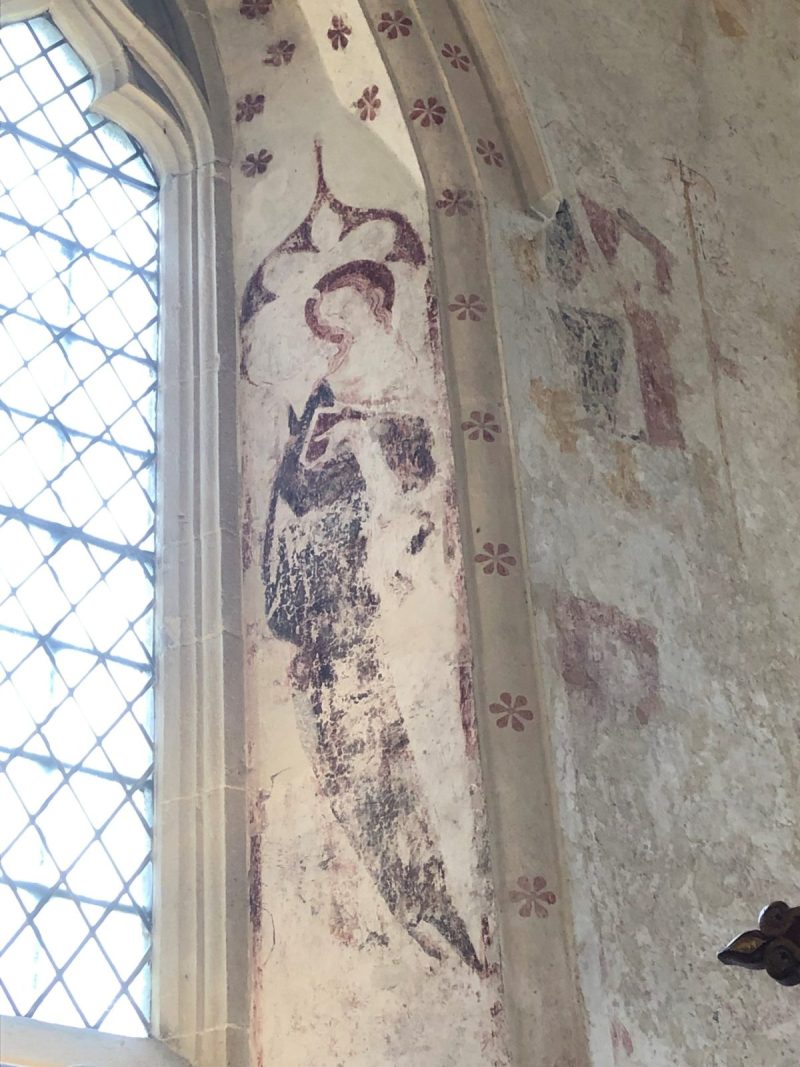
Image: The Virgin Mary. Wall painting on the East splay of the Annunciation window (north wall) in the Chancel of the Church of St Mary the Virgin, Chalgrove, Oxfordshire. Photo by Dr Michelle Castelletti.
KEYNOTE SPEAKER ABSTRACTS
Professor Elizabeth Gemmill
Proclamation, Authentication, Degradation: signs and symbols in late medieval Scotland
This paper looks at how quite ordinary people in late medieval Scotland (and not just persons of wealth and influence) needed to use and understand signs and symbols in their daily lives and work. Marks and tokens were used to authenticate deeds, to guarantee the quality of craftsmanship, to attest to the ownership of commodities traded overseas, to advertise goods for sale, to proclaim citizenship, and to warn against imminent dangers such as plague, war, or deceitful traders. Symbolic actions underpinned the operation of the law and shamed those who broke it. But if signs and symbols had such salience it matters to know how their use (or abuse) was controlled, by whom and to what purpose, and what this might tell us about the operation of power.
Dr Christine Jackson
Curating courtly and intellectual image and reputation in early Stuart Britain: an introduction to the art of self-presentation in the life and works of Edward, Lord Herbert of Cherbury (1582-1648)
Lionised by his admirers as the embodiment of knightly chivalry and noble learning, and castigated by his detractors as a duellist, intellectual dilettante and deist, Lord Herbert of Cherbury was a colourful seventeenth-century nobleman who enthusiastically pursued overlapping careers as a county governor, courtier, soldier, ambassador and published scholar. From his pious teenage years at Oxford to his controversial deathbed in London, he was driven by upbringing, temperament, ambition and political rivalry to pay careful attention to the fashioning and reception of his image and reputation as he negotiated the opportunities and challenges life offered him. This paper will explore how Lord Herbert consciously martialled material objects and visual display to shape and enhance his self-presentation.
Dr Lynn Robson
Ladies of Wool: Hilary Mantel and tapestries of Queen Esther and the Queen of Sheba
In her Wolf Hall trilogy of novels, Hilary Mantel uses tapestry depictions of two biblical queens – Queen Esther and the Queen of Sheba – to weave together imaginative fiction and historical authenticity. This lecture will explore the role of woven objects in Mantel’s creation of her fictionalised Tudor world and consider the significance of the act of seeing/gazing to the interpretation of literary texts, works of art, and the art of research.


0 Comments